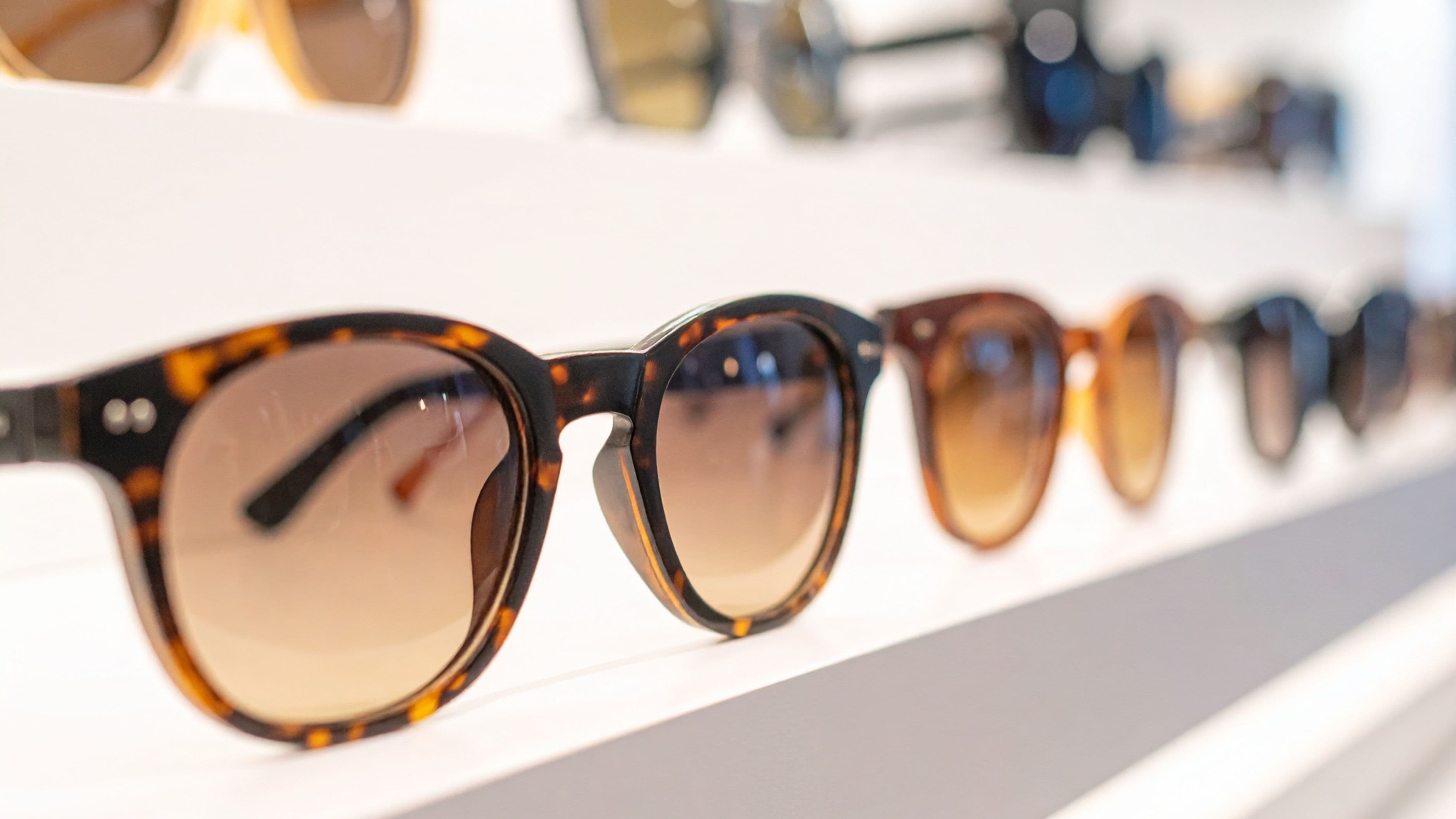
The brands on this list aren't necessarily the most expensive options on the market. They're the ones that consistently deliver on optics, durability, and design – whether you're an outdoor athlete, a daily commuter, or someone who just wants a solid pair they won't regret buying.
Top 10 Sunglasses Brands at a Glance
Ray-Ban – The timeless everyday classic
Oakley – The performance standard
Maui Jim – The best lenses for outdoor clarity
Persol – Italian craftsmanship and style
Costa Del Mar – Built for water and bright light
Warby Parker – Smart value with real quality
Oliver Peoples – Quiet luxury done right
Gucci – Fashion-forward with lasting build
Serengeti – Photochromic lenses for changing conditions
Tom Ford – Bold style with strong construction
1 – Ray-Ban
Best for: Everyday wear, style versatility, and classic looks
Ray-Ban has been one of the most recognizable names in eyewear since the 1930s, and for good reason – they've never really stopped being relevant. The Wayfarer and Aviator silhouettes are genuinely timeless, worn across generations without looking dated. But beyond the aesthetics, Ray-Ban's core lineup delivers solid UV400 protection, impact-resistant polycarbonate or glass lenses, and frames built to handle daily use.
Where Ray-Ban earns its place on this list is consistency. You know what you're getting: a well-made pair that fits most face shapes, holds up over time, and looks appropriate in almost any setting – casual, semi-formal, outdoors, or driving. Their prescription options are also widely available, making them a practical choice for people who need corrective lenses in their sunglasses.
The main drawback is that the brand's popularity means you'll see them everywhere. If you're looking for something more individual, other options on this list might be a better fit. But for a reliable, stylish, go-anywhere pair, Ray-Ban remains a benchmark.
Price range: $100–$250
Best for: Everyday wear, versatile styling, first investment pair
Drawback: Very common – limited exclusivity
2 – Oakley
Best for: Sports, outdoor activities, and high-performance optics
Oakley built its reputation in action sports, and decades later it still sets the standard for performance eyewear. Their Prizm lens technology is genuinely impressive – it's engineered to enhance contrast and color detail for specific environments, whether that's road cycling, trail running, skiing, or fishing. The difference in visual clarity compared to a standard tinted lens is noticeable, not marginal.
The frames are designed for function first: lightweight O-Matter or lightweight metal builds, secure fit systems that keep them in place during high-movement activities, and impact-resistant lenses that meet ANSI Z87.1 safety standards. If you spend meaningful time outdoors or play any sport where eyewear matters, Oakley is the most purpose-built option on this list.
The aesthetic is sporty and modern, which makes them less suitable for formal or business settings. But if you want a pair you can actually trust during physical activity – and that won't slide off your face on a long run – Oakley is hard to beat.
Price range: $100–$300+
Best for: Athletes, cyclists, skiers, outdoor enthusiasts
Drawback: Sporty aesthetic limits versatility in formal settings
3 – Maui Jim
Best for: Outdoor clarity, glare reduction, and true color accuracy
Maui Jim doesn't get enough mainstream attention outside of outdoor and fishing communities, but their PolarizedPlus2 lens technology is arguably the best polarization available at the consumer level. The lenses don't just block glare – they enhance color vibrancy and depth in a way that makes outdoor environments look sharper and more defined. Spend a day on the water or in the mountains with a pair of Maui Jims and then switch back to a standard pair, and the difference is immediately obvious.
The brand started in Hawaii and built its lenses specifically for intense tropical light conditions, which means they're engineered for high-brightness environments where cheaper polarized lenses often fall short. Their BioClear lens material also offers excellent scratch resistance and optical clarity without the weight of glass.
Frames are available across sporty, wrap, and lifestyle styles, making them versatile enough for both athletic use and everyday wear. They're on the pricier side, but for anyone who spends significant time in high-glare environments, the optical performance justifies the cost.
Price range: $150–$350
Best for: Fishing, water sports, driving, high-glare outdoor environments
Drawback: Higher price point; fewer fashion-forward frame options
4 – Persol
Best for: Refined European style and handcrafted quality
Persol is an Italian brand with roots going back to 1917, and they bring old-world craftsmanship to a category that often prioritizes speed over quality. Their signature Meflecto system – a patented flexible hinge mechanism – means the temples adapt to the shape of your head rather than forcing a rigid fit. It's a small detail that makes a significant difference in long-wearing comfort.
The lenses are optical glass or high-quality crystal, which delivers exceptional clarity and scratch resistance. The frames are acetate, hand-finished in Italy, and available in a range of classic and slightly eccentric shapes that stand apart from the mainstream without being outlandish. If you appreciate design objects that are built to last and age well, Persol fits that aesthetic better than most brands at their price point.
They're less suited to athletic use – these aren't performance sunglasses – but for someone who wants a pair that looks polished on vacation, during travel, or as a statement piece in everyday life, Persol is one of the best-value luxury options available.
Price range: $200–$400
Best for: Everyday elegance, style-focused buyers, European fashion sensibility
Drawback: Not built for sports or high-activity use
5 – Costa Del Mar
Best for: Fishing, boating, and serious water environments
Costa Del Mar exists for one purpose: cutting glare on and around water. Their 580 lens technology filters specific wavelengths of light that cause the most eye strain on reflective surfaces, while their polarization is among the most effective available for aquatic environments. If you fish, sail, kayak, or spend extended time near water, Costa is the brand that serious anglers and water sports enthusiasts consistently come back to.
The frames are built for durability rather than delicacy – bio-based resin materials, corrosion-resistant stainless steel, and Hydrolite nose and temple pads that grip better when wet. These are sunglasses designed to be worn hard, get wet repeatedly, and keep working. The lens options include glass and polycarbonate in a range of tints optimized for different light and water conditions.
Outside of water environments, Costa's aesthetic is rugged and functional rather than fashion-forward. They're not the pair you'd wear to dinner. But for their intended use case, very few brands come close.
Price range: $150–$300
Best for: Fishing, boating, kayaking, outdoor water activities
Drawback: Style is too functional/utilitarian for fashion-conscious buyers
6 – Warby Parker
Best for: Quality at a reasonable price, prescription sunglasses, and modern design
Warby Parker disrupted the eyewear industry by cutting out the middleman and selling directly to consumers – which means you get genuinely good quality at a price that doesn't require justification. Their frames are lightweight and well-designed, available in acetate and titanium, and their prescription lenses are made with the same rigor as a full optical lab.
What makes Warby Parker worth the investment is their lens quality. Standard scratch-resistant, anti-reflective lenses come included, and their polarized upgrade is reasonably priced. The optical quality is solid, the frame selection is modern without being trendy, and the try-at-home program makes it easier to find the right fit without guessing. For people who need prescription sunglasses and don't want to pay luxury brand markup, Warby Parker is the most practical answer on this list.
They don't have the performance credentials of Oakley or the heritage of Persol, but as an everyday pair that balances quality, design, and price, they consistently over-deliver relative to their cost.
Price range: $95–$200
Best for: Prescription sunglasses, value-conscious buyers, modern minimalist style
Drawback: Less brand prestige; not suitable for athletic use
7 – Oliver Peoples
Best for: Understated luxury, premium acetate quality, and timeless aesthetics
Oliver Peoples operates at the intersection of fashion and craftsmanship in a way that doesn't announce itself loudly. The frames are made from high-grade Japanese acetate, the hinges are precise and built to last, and the overall construction quality is noticeably above most brands in the luxury category. They're a favorite among architects, creatives, and anyone who appreciates quality objects that don't rely on flashy branding.
The lens quality is excellent across their lineup, and many frames are available with photochromic or gradient lenses that transition well in varied light. The designs lean toward rounded, vintage-influenced shapes that work particularly well for people who want something distinctive without being ostentatious. Celebrities and fashion insiders frequently wear Oliver Peoples precisely because the brand doesn't broadcast itself.
At their price point, you're paying for genuine material quality and design sensibility rather than marketing spend. If quiet, well-made luxury matters to you, Oliver Peoples is one of the best choices in this category.
Price range: $300–$600
Best for: Fashion-conscious buyers who prefer understated luxury
Drawback: High price; not designed for outdoor performance
8 – Gucci
Best for: Fashion-forward buyers who want bold style with a substantial build
Gucci sunglasses sit firmly in the luxury fashion category, and they make no apologies for it. The frames are bold, distinctive, and carry a recognizable aesthetic that changes year to year while maintaining a consistent sense of intentionality. For buyers who view sunglasses as part of a fashion statement rather than purely functional eyewear, Gucci delivers a product that's genuinely well-made behind the brand name.
The frames use high-quality acetate and metal, the hinges are solid, and the lenses – while not performance-grade – offer full UV400 protection and decent optical quality. Gucci also regularly collaborates with designers and releases limited editions, which appeals to collectors and fashion enthusiasts. The resale value on well-maintained pairs also tends to hold better than most fashion eyewear brands.
The honest caveat: a significant portion of the price is the brand identity, not the lens technology. If optical performance is your primary concern, there are better choices on this list. But if you want sunglasses that make an impression and are built well enough to justify the cost, Gucci is a legitimate option.
Price range: $300–$700+
Best for: Fashion-first buyers, luxury accessory collectors
Drawback: Price premium driven partly by brand; optical performance not top-tier
9 – Serengeti
Best for: Driving, variable light conditions, and photochromic performance
Serengeti is a specialist brand that most people haven't heard of, but among drivers and outdoor enthusiasts who've tried them, they develop a loyal following quickly. Their photochromic technology automatically adjusts lens darkness based on available light – in bright sunlight they're dark, in shade or overcast conditions they lighten – which makes them exceptionally versatile for conditions that change throughout the day.
Their Spectral Control technology also filters specific light frequencies associated with eye strain and glare, and the optical quality of their lenses is consistently rated among the best in the photochromic category. The frames are Italian-designed, reasonably stylish, and available in polarized options as well. For long-distance drivers, golfers, or anyone who spends time moving between different light environments, Serengeti solves a problem most other brands don't address as directly.
They're not a fashion brand, and the frame selection is more functional than editorial. But if performance and adaptability in varying light conditions matter more than aesthetics, Serengeti deserves serious consideration.
Price range: $150–$350
Best for: Driving, golf, hiking, variable-light outdoor activities
Drawback: Limited fashion appeal; smaller frame selection
10 – Tom Ford
Best for: Bold, sophisticated style with strong build quality
Tom Ford occupies a similar space to Gucci but with a slightly different aesthetic – more dramatic shapes, a signature T logo, and a design language that leans into confident, cinematic style. The frames are well-constructed, typically using Italian acetate or high-quality metal, and the hinges and fit are solid enough that these hold up as everyday wearers rather than just display pieces.
Lens quality is good – full UV protection, solid optical clarity, and available in polarized options for an upcharge. Like Gucci, you're paying a premium for the design identity, but unlike some fashion eyewear, Tom Ford frames are genuinely comfortable and durable enough to be worn regularly rather than saved for occasions.
The brand is particularly strong for people who want bold, recognizable frames that still read as elegant rather than flashy. They're a strong choice for anyone who wants a fashion-forward pair with enough build quality to use daily without feeling like they're babying an investment.
Price range: $350–$700+
Best for: Style-focused buyers wanting boldness with sophistication
Drawback: High price; optical performance secondary to design
How to Choose the Right Brand for You
With ten strong options, the right choice depends on what you're actually buying sunglasses for.
For performance and sport: Oakley and Costa Del Mar are the clear leaders. Oakley wins for versatility across land-based activities; Costa is the choice for water.
For optical quality and glare reduction: Maui Jim leads, followed closely by Costa. If you spend serious time outdoors, neither will disappoint.
For everyday style on a reasonable budget: Ray-Ban and Warby Parker deliver the best balance of quality, price, and design.
For understated luxury: Oliver Peoples and Persol are the strongest choices – both are beautifully made without relying on loud branding.
For fashion and statement: Gucci and Tom Ford are built for buyers who prioritize aesthetic impact, with Gucci leaning more editorial and Tom Ford leaning dramatic.
For driving or variable light conditions: Serengeti is purpose-built for this use case and punches above its weight in optical adaptability.
What to Look for Beyond the Brand
Brand name matters less than lens quality. Whatever you buy, make sure the lenses provide 100% UV400 protection – that's protection against both UVA and UVB rays. Polarization is worth paying for if you're regularly near water, driving, or in high-glare environments; it dramatically reduces eye strain and improves contrast.
Frame fit is often overlooked. A premium lens in a frame that doesn't fit well will be uncomfortable to wear and easy to damage. If possible, try before you buy, or choose a brand with a solid return policy.
Lens material also matters: glass offers superior optical clarity and scratch resistance but adds weight and shatters on impact; polycarbonate is lightweight and impact-resistant but can scratch more easily; nylon-based materials like Oakley's O-Matter split the difference for performance applications.
FAQ
Are expensive sunglasses actually better for your eyes? Yes and no. UV protection doesn't correlate with price – a $20 pair with proper UV400 labeling protects your eyes as well as a $500 pair in that specific respect. What you do pay for in premium sunglasses is lens clarity, optical accuracy, polarization quality, and build durability. Better optics reduce eye strain over time, which matters if you wear them heavily.
How long should a quality pair of sunglasses last? With reasonable care, a well-made pair from any brand on this list should last 3–7 years or more. Frame and hinge quality is usually the limiting factor, not the lenses.
Is polarization always worth it? Polarization is worth it if you spend time near water, drive frequently, or are regularly in high-glare environments. For general city use with varied light, it's nice to have but not essential. Just be aware that polarized lenses can make some digital screens harder to read.
Can I get prescription lenses in any of these brands? Most brands on this list offer prescription lens options, either directly or through partner optical labs. Warby Parker, Ray-Ban, and Oliver Peoples have the most seamless prescription integration. For performance brands like Oakley and Costa, prescription options exist but may be more limited by frame design.
What's the best sunglasses brand for driving specifically? Serengeti and Maui Jim are both excellent for driving – Serengeti for their photochromic adaptability in changing light, and Maui Jim for pure polarization and glare reduction in bright conditions.
The Bottom Line
The best sunglasses brand for you is the one that matches how you actually live – how often you wear them, where you wear them, and what matters more to you: optical performance, style, or a balance of both.
If you've been wearing cheap pairs and replacing them every year, moving to one quality pair is a genuinely worthwhile upgrade. The optics are better, the fit is more comfortable, and the best pairs on this list will still be working just as well three years from now.
Pick the one that fits your use case, wear them often, and clean the lenses properly. That's the whole strategy.
📚 Sources
American Academy of Ophthalmology – "Sunglasses: How to Choose the Right Pair": https://www.aao.org/eye-health/tips-prevention/sunglasses
Oakley – Prizm Lens Technology Overview: https://www.oakley.com/en-us/technology/prizm-science
Maui Jim – PolarizedPlus2 Technology: https://www.mauijim.com/US/en_US/lenses
Costa Del Mar – 580 Lens Technology: https://www.costadelmar.com/en-us/580-lens-technology
Serengeti Eyewear – Photochromic Lens Technology: https://www.serengetieyewear.com/pages/lens-technology
Wirecutter (NY Times) – "The Best Sunglasses": https://www.nytimes.com/wirecutter/reviews/best-sunglasses/
GQ – "The Best Sunglasses Brands for Every Budget": https://www.gq.com/story/best-sunglasses-brands