
These 10 tips fix that. No fluff, no "just practice every day." Real, actionable advice that will get you playing actual music faster than you think.
Top 10 at a Glance
Start on the right guitar for your goals
Learn chords before scales
Practice in short daily sessions — not long weekly ones
Use your fingertip pain as a progress tracker
Learn songs you actually love from day one
Master three chords before moving on
Use free and paid online resources strategically
Record yourself — even briefly
Find one other person to play with
Accept "good enough for now" and keep moving

The Full List
1. Start on the Right Guitar for Your Goals
The guitar you choose in week one affects everything — your comfort, your motivation, and your fingertip pain.
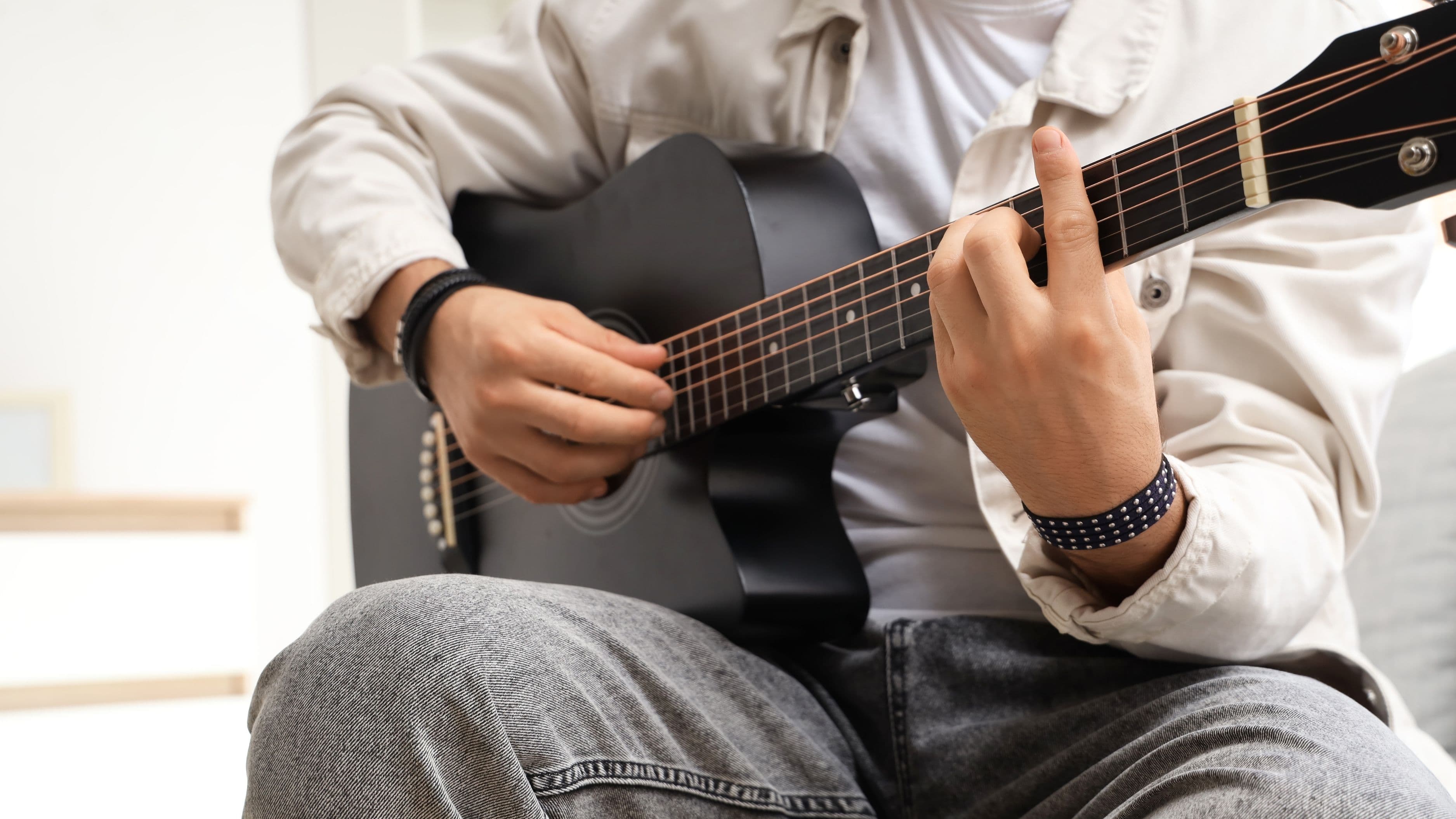
For most beginners, a steel-string acoustic is the best all-rounder. It's versatile, affordable, and needs no extra gear. If you love rock or blues, go electric — the strings are lighter and easier on fingertips. Classical/nylon-string guitars are gentler on fingers but harder to learn chord transitions on.
Aim to spend £100–£200 / $120–$250 on a starter guitar. Below that range, intonation issues will make you think you're playing wrong when the instrument is actually just out of tune.
Key benefit: the right guitar removes physical friction from the learning process so you can focus on technique.
Quick tip: go to a music shop and hold a few before buying. Comfort matters more than looks.
2. Learn Chords Before Scales
Scales make you a better guitarist. Chords make you a guitarist right now.
Most beginner teachers push scales too early. The problem is that scales alone don't sound like music — you can't sit down and play a song with a pentatonic scale in week two. But you can with three chords.
Start with G, C, and D (acoustic/folk/pop) or E minor, A minor, and D (folk/rock). These three combinations unlock hundreds of songs across every genre.
Once you can transition smoothly between chords without looking at your fingers, then start adding scales.
Key benefit: you make real music faster, which keeps motivation high during the difficult early weeks.
3. Practice in Short Daily Sessions — Not Long Weekly Ones
Twenty minutes a day beats two hours every Saturday. Every time.
Guitar is a physical skill. Your fingers need to build muscle memory and calluses gradually. Long, infrequent sessions cause frustration and soreness without the reinforcement that makes skills stick.
Put your guitar somewhere visible — not in a case in a cupboard. The easier it is to pick up, the more often you will.
A good beginner structure: 5 minutes reviewing something you already know, 10 minutes on a new skill or song section, 5 minutes playing something for fun.
Key benefit: daily practice creates neurological grooves that make everything faster and more automatic.
Quick tip: even 10 minutes counts. A "too short to matter" session is still better than none.
4. Use Your Fingertip Pain as a Progress Tracker
Fingertip soreness in weeks 1–3 is not a sign you're doing it wrong — it's a sign you're building calluses.
Every adult beginner hits this. Your fingertips aren't used to pressing metal strings against a fretboard. The solution is not to push through pain aggressively (that causes injury) or to stop entirely (that resets your progress).
Instead: play until mild discomfort, stop, and return the next day. Within 3–4 weeks, the sensitivity disappears almost entirely. Classical and flamenco guitarists have had this same experience for centuries.
Key benefit: understanding the pain process stops most adults from quitting at the exact moment they're about to break through.
Quick tip: nylon string guitars are noticeably kinder on fingertips during the callus-building phase.
5. Learn Songs You Actually Love From Day One
This is the most important motivational tip on this list. Don't spend your early weeks on exercises that feel like homework.
Yes, there are foundational techniques to learn. But every one of those techniques should be practiced in the context of a real song you want to play. Even if you can only play part of it, it should be music you care about.
Find a simple version of a song you love — "Wonderwall" (Oasis), "Horse With No Name" (America), "Wish You Were Here" (Pink Floyd), or any song from your actual playlist — and work toward it.
Key benefit: emotional connection to the music is the single strongest predictor of whether adults stick with guitar long-term.
Quick tip: sites like Ultimate Guitar (ultimate-guitar.com) have simplified chord versions of virtually every song ever recorded.
6. Master Three Chords Before Moving On
Adult learners often make the mistake of learning ten chords badly instead of three chords well.
"Mastering" a chord means you can press it cleanly (no buzzing), transition to it from another chord without looking, and switch to it mid-strum without losing the rhythm. That's the bar.
Until you hit it with your core three chords, adding more just creates noise. Once you're there, new chords take a fraction of the time to learn because your fingers understand how the fretboard works.
Key benefit: depth before breadth accelerates total progress significantly.
Quick tip: practice transitions by setting a timer for two minutes and just switching between two chords repeatedly. It's boring and it works.
7. Use Free and Paid Online Resources Strategically
There has never been a better time to learn guitar. The problem isn't finding resources — it's choosing the right ones and not getting overwhelmed.
For structured beginner learning, JustinGuitar (justinguitar.com) is widely considered the best free resource in the world. It's methodical, well-paced, and genuinely comprehensive.
For specific song tutorials, YouTube is unmatched. Search "[song name] guitar tutorial beginner" and pick a teacher whose pace suits you.
For paid options, platforms like Fender Play, Yousician, or TakeLessons offer structured progression with feedback. Worth it if you struggle with self-direction.
Key benefit: the right resource matches your learning style and stops you from wasting weeks on the wrong material.
Quick tip: pick one resource and stick with it for at least 8 weeks before switching. Bouncing between teachers is a common progress-killer.
8. Record Yourself — Even Briefly
Most adult learners skip this step and it costs them months of progress.
Your ear hears your playing differently when you're focused on performing than when you listen back to a recording. Chord buzzes, timing drift, and hesitations between transitions are all much clearer on playback. A 60-second phone recording after each session is enough.
This isn't about judgment — it's about data. You'll spot specific problems you can then fix deliberately, rather than repeating the same mistakes and wondering why you're not improving.
Key benefit: objective feedback accelerates skill refinement faster than any amount of "just practising."
Quick tip: compare a recording from week 2 with one from week 6. The improvement will motivate you more than almost anything else.
9. Find One Other Person to Play With
Playing alone in your living room is fine. Playing with someone else is transformative.
You don't need a bandmate — just another beginner at a similar level. A friend who also wants to learn, a weekly open mic to attend as an observer, or even an online community (r/guitarlessons on Reddit is genuinely supportive) can make a massive difference.
Accountability, shared troubleshooting, and the joy of making music together add dimensions to learning that solo practice can't replicate.
Key benefit: social commitment dramatically increases follow-through and long-term consistency.
Quick tip: local community music groups, adult education centres, and music shops often run beginner group classes — affordable and surprisingly effective.
10. Accept "Good Enough for Now" and Keep Moving
Perfectionism is the most common reason adult guitar learners stall.
You will want to perfect every chord before moving on. You will want your transitions to be flawless before you try a full song. Resist this.
Progress in guitar is not linear — you learn things imperfectly, move forward, and they improve in the background while you focus on something new.
"Good enough for now" means: it sounds roughly right, I know what I'm going for, and I can build on it. That's the signal to move forward, not to repeat the same exercise another 50 times until it's pristine.
Key benefit: keeps momentum alive through the natural plateau phases every learner experiences.
Quick tip: set a specific weekly goal ("I'll be able to strum through the verse of this song") rather than an open-ended one ("I'll get better at chords"). Concrete goals are easier to achieve and easier to move on from.
Quick Takeaway
The biggest mistake adult learners make is treating guitar like an academic subject — studying it rather than playing it. Start with chords, learn songs you love, practice a little every day, and resist the urge to perfect everything before moving forward.
Three months of smart, consistent practice will get you further than three years of occasional, unfocused noodling. Pick it up, play something, and do it again tomorrow.
FAQ
Is it too late to start guitar as an adult? Not even close. Adults learn efficiently because they understand how to practice deliberately, can self-diagnose problems, and have real motivation. Many professional guitarists started in their 20s, 30s, or later.
Do I need to learn to read music? No. Most guitarists — including many professionals — use chord charts and tablature (tabs) instead of standard notation. Tabs are easy to learn in a single afternoon.
How long before I can play a real song? With consistent daily practice, most beginners can strum through a simple 3-chord song within 4–6 weeks. A song that sounds genuinely impressive? Allow 3–6 months.
Acoustic or electric for a complete beginner? Either works. Acoustic builds finger strength faster and needs no extra gear. Electric is easier on fingertips and better if your goal is rock or blues. Both teach the same fundamentals.
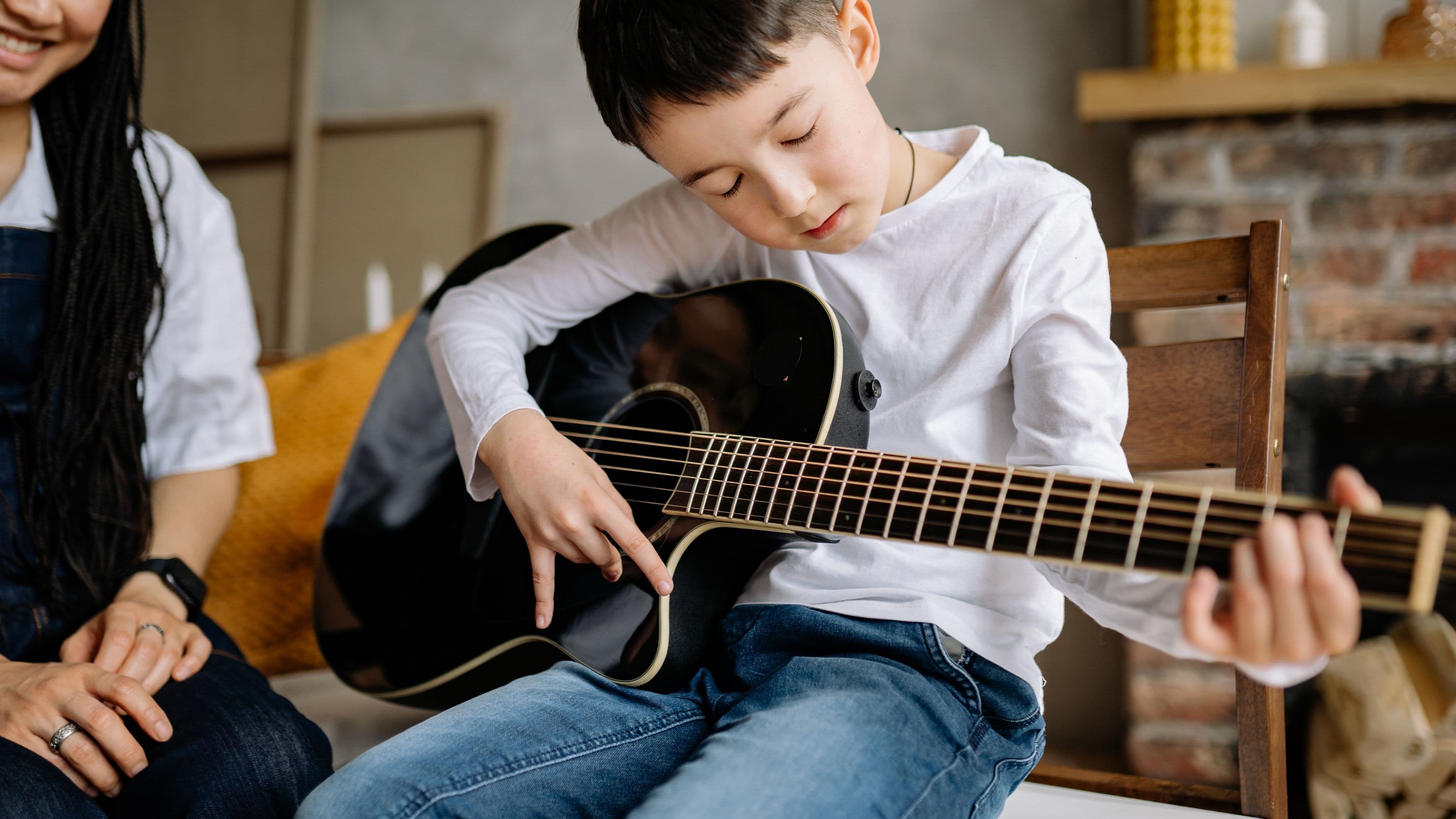
Do I need a teacher, or can I self-teach? Most adults successfully self-teach with good online resources. A teacher adds value by catching bad habits early — if budget allows, even 4–6 lessons at the start can set you up for years of productive self-teaching.
How much should I practise per day? 15–20 minutes daily is the sweet spot for beginners. More is fine when you're enjoying it — but consistency matters far more than total hours.
Final Word
Guitar is one of the most rewarding instruments an adult can pick up. The first few weeks are the hardest — fingers hurt, chords buzz, transitions feel impossible. Push through that wall and you'll discover something that pays dividends for the rest of your life.
Start today. Tune your guitar, learn G, C, and D, and find one song you love. That's it. The rest follows from there.
📚 Sources
JustinGuitar, Beginner Course & Method — justinguitar.com
Fender, "How Long Does It Take to Learn Guitar?" — fender.com
Psychology of Music, "Adult Music Learning and Motivation" — journals.sagepub.com
Guitar World, Beginner technique guides — guitarworld.com
The Royal Conservatory of Music, Adult Learner Research Summaries — rcmusic.com
Ultimate Guitar, Chord and tab database — ultimate-guitar.com
Reddit r/guitarlessons, Community learning guides — reddit.com/r/guitarlessons
Music Teachers National Association (MTNA), Adult learning resources — mtna.org
Berklee Online, Guitar fundamentals course notes — online.berklee.edu
American Music Conference, "Benefits of Music Learning in Adulthood" — amc-music.org